New version of Johannes Vermeer
Girl reading a letter by an open window by Johannes Vermeer

Girl reading a letter by an open window by Johannes Vermeer
Art Terms: Underpainting In art, an underpainting is an initial layer of paint applied to a ground, which serves as a base for subsequent layers of paint. Underpaintings are often monochromatic and help to define colour values for later painting. There are several different types of underpainting, such as verdaccio and grisaille. Underpainting gets its name because it is painting that is intended to be painted over (see overpainting) in a system of working in layers. There is a popular misconception that underpainting should be monochromatic, perhaps in gray-scales. In fact, a multi-color underpainting is much more useful and was used extensively by artists such as Giotto (whose technique is described in detail by Cennino Cennini), as well as by…
Art Terms: Brunaille A Brunaille is a painting executed entirely or primarily in shades of brown. Such a painting is described as having been painted “en brunaille“. Brunaille has its roots in 12th century stained glass made for Cistercian monasteries which in 1134 prohibited the use of color in their art. However, it was only in the early 17th century that the French term “brunaille” was coined to describe pictures painted in shades of brown. Brunaille are less common than paintings executed in grey (grisaille).
Painting techniques – Chiaroscuro Chiaroscuro (Italian: “light-dark”) in art is characterized by strong contrasts between light and dark, usually bold contrasts affecting a whole composition. It is also a technical term used by artists and art historians for using contrasts of light to achieve a sense of volume in modeling three-dimensional objects such as the human body. Further specialized uses include chiaroscuro woodcut, for coloured woodcuts printed with different blocks, each using a different coloured ink; and chiaroscuro drawing for drawings on coloured paper with drawing in a dark medium and white highlighting. Similar effects in the lighting of cinema and photography are also chiaroscuro. Origin in the chiaroscuro drawing Chiaroscuro originated during the Renaissance as drawing on coloured paper,…
Painting techniques – Tenebrism Tenebrism, from the Italian tenebroso (“murky”), (also called dramatic illumination) is a style of painting using very pronounced chiaroscuro, where there are violent contrasts of light and dark, and darkness becomes a dominating feature of the image. Caravaggio is generally credited with the invention of the style, but the term “Tenebrist” is more likely to be applied to later painters under his influence. However, Caravaggio is so closely associated with Tenebrism, that the word “Caravaggism” is sometimes applied in an almost synonymous fashion, or the phrase “Caravaggesque tenebrism” is sometimes used. The term is less used by art historians in recent decades, and lacks a clear definition. The word is capitalised by some art historians, and…
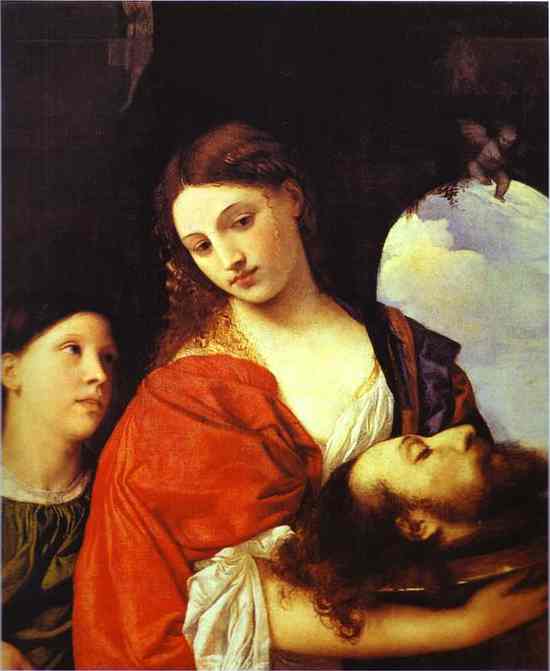
Classical painting techniques – Sfumato Sfumato is one of the four canonical painting modes of the Renaissance (the other three being Cangiante, Chiaroscuro, and Unione). It corresponds to the concept of ‘low-contrast’ in photography. The Italian word sfumato (pp. of sfumare, ‘to vanish’ or ‘to shade’) captures the idea precisely. The finished product appears as though a veil of smoke had drifted between the subject of the painting and the viewer, adding some brightness to the pure darks and blocking some of the pure brights of the subject. It is not a difficult technique in practice. It requires competence in brushwork and judgement of value (brightness) but does not necessarily require a high degree of skill. It consists in painting…
Painting techniques – Cangiante Cangiante is one of the four canonical painting modes of the Renaissance (the other three being Unione, Chiaroscuro, and Sfumato). The word itself derives from the Italian cangiare (“to change”). Cangiante is characterized by the painter’s changing to a different, lighter, hue when the original hue cannot be made light enough or, on the converse, changing to a darker hue when the original hue cannot be made dark enough. The painter may change, for example, from the color yellow to the color red (regardless of the object’s actual color) when painting shadows on a yellow object simply because the yellow he has to work with cannot be made dark enough to render shadows on that object…
Classical painting techniques: Perspective Part 3 The use of Perspective: The first major treatment of the painting as a window into space appeared in the work of Giotto di Bondone, at the beginning of the 14th century. True linear perspective was formalized later, by Filippo BrunelleschiLeon Battista Alberti. In addition to giving a more realistic presentation of art, it moved Renaissance painters into composing more paintings. Prior to the Renaissance, a clearly modern optical basis of perspective was given in 1021, when Alhazen (al-Hasan Ibn al-Haytham, d. ca. 1041 CE), an Iraqi physicist and mathematician, in his Book of Optics (Kitab al-manazir; known in Latin as De aspectibus or Perspectiva), explained that light projects conically into the eye. Alhazen’s geometrical,…
Art Terms: Grisaille Grisaille is a term for painting executed entirely in monochrome or near-monochrome, usually in shades of grey. It is particularly used in large decorative schemes in imitation of sculpture. Many grisailles in fact include a slightly wider colour range, like the Andrea del Sarto fresco illustrated. Paintings executed in brown are sometimes referred to by the more specific term brunaille, and paintings executed in green are sometimes called verdaille. A grisaille may be executed for its own sake, as underpainting for an oil painting (in preparation for glazing layers of colour over it), or as a model for an engraver to work from. “Rubens and his school sometimes use monochrome techniques in sketching compositions for engravers.” Full…

Massacre of the Innocents (1611) by Peter Paul Rubens. Massacre of the Innocents (1611) by Peter Paul Rubens. Sold for £49.5m in 2002, at Sotheby’s, London. This work by the Flemish Baroque artist is the most expensive painting by an Old Master.