On 5 Dec, 2010 With
This work was afterwards destroyed by fire, but the composition has been preserved by the burin of Fontana. His next performance was his celebrated picture of St. Pietro Martire, in the church of SS. Giovanni e Paolo, at Venice, which is generally regarded as his master-piece in historical paint[Pg 3]ing. This picture was carried to Paris by the French, and subsequently restored by the Allies. Notwithstanding the importance of these and other commissions, and the great reputation he had acquired, it is said, though with little probability of truth, that he received such a small remuneration for his works, that he was in actual indigence in 1530, when the praises bestowed upon him in the writings of his friend Pietro…
Read More
On 3 Dec, 2010 With
Rousseau and Picasso. Whilst the public often ridiculed Rousseau’s work and organisers of the official Salon exhibitions rejected his submissions, he was admired by a younger generation of avant-garde artists, many of whom also lived and worked in Montparnasse at various points in their careers. This group of artists included Picasso, who bought several of Rousseau’s paintings and held a legendary banquet, ‘Le Banquet Rousseau’, in his honour. Many of these younger artists were fascinated by so-called ‘primitive’ art, discovering a powerful form of expression in African tribal masks and other non-Western artefacts. For them, Rousseau was a homegrown curiosity, a ‘modern primitive’ whose paintings captured something of the vitality they admired in these other art forms. Picasso purchased Rousseau’s…
Read More
On 30 Nov, 2010 With
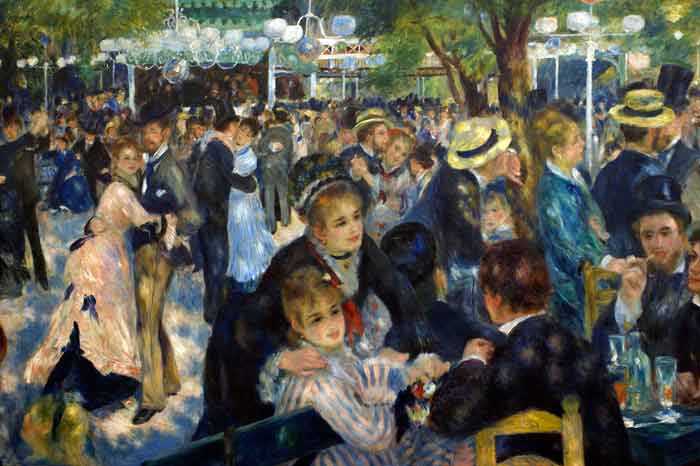
• Bal Au Moulin de la Galette (1876) by Pierre-Auguste Renoir. Sold for $78.1 million in 1990 at Sotheby’s, New York.
Read More
On 29 Nov, 2010 With
Cynical realism Cynical realism is a contemporary movement in Chinese art, especially in the form of painting, that began in the 1990s. Beginning in Beijing, it has become the most popular Chinesecontemporary art movement in mainland China. It arose through the pursuit of individual expression by Chinese artists that broke away from the collective mindset that existed since theCultural Revolution. The major themes tend to focus on socio-political issues and events since Revolutionary China (1911) to the present. These include having a, usually humorous and post-ironic, take on a realist perspective and interpretation of transition that Chinese society has been through, from the advent of Communism to today’s industrialization andmodernization. Artists associated with Cynical Realism include Fang Lijun, Liu Wei, and Yue Minjun.
Read More
On 27 Nov, 2010 With
American realism was a turn of the century idea in art, music and literature that showed through these different types of work, reflections of the time period. Whether it was a cultural portrayal, or a scenic view of downtown New York City, these images and works of literature, music and painting depicted a contemporary view of what was happening; an attempt at defining what was real. In America at the beginning of the 20th century a new generation of painters, writers and journalists were coming of age. Many of the painters felt the influence of older American artists like Thomas Eakins, Mary Cassatt, John Singer Sargent, James McNeill Whistler, Winslow Homer, Childe Hassam, J. Alden Weir, Thomas Pollock Anshutz, and William Merritt Chase. However they were interested in creating…
Read More
On 26 Nov, 2010 With
His Titania (also engraved in the Shakspeare Gallery), overflows with elvish fun and imaginative drollery. It professes to embody that portion of the first scene in the fourth act where the spell-blinded queen caresses Bottom the weaver, on whose shoulders Oberon’s transforming wand has placed an ass’ head. Titania, a gay and alluring being, attended by her troop of fairies, is endeavoring to seem as lovely as possible in the sight of her lover, who holds down his head and assumes the air of the most stupid of all creatures. One almost imagines that her ripe round lips are uttering the well-known words,— “Come sit thee down upon this flowery bed, While I thy amiable cheeks do coy, And stick…
Read More
On 25 Nov, 2010 With
Odd Nerdrum´s self portrait is titled «The Savior of Painting». Almost life-size, it depicts the artist in a golden robe, armed with paintbrush and palette, against the soft Norwegian evening sky. On his palette is one single color: that of gold. «This is kitsch in its purest form,» remarks the artist in front of the nearly finished work, gracefully saving us the embarrassment. «Mind you, there´s absolutely no irony here.» The golden robe is for real. He had it made in New York a few years back, and it´s already a garment of international notoriety. His «Self Portrait in Golden Robe», first exhibited in Stockholm last winter and now showing in a retrospective at the Astrup-Fearnley Museum in Oslo, shows…
Read More
On 24 Nov, 2010 With
The Importance of Being Odd: Nerdrum’s Challenge to Modernism By Paul A. Cantor The Norwegian artist Odd Nerdrum is one of the greatest painters of the century. Unfortunately, according to his detractors, the century in question is the seventeenth. Thus Nerdrum has emerged as one of the most controversial artists of our day. His admirers praise him for his superb Old Master technique, while his critics condemn him as hopelessly reactionary. His work calls into question all our customary narratives about art history, and especially the modernist dogma that the artist can be creative only by turning his back on the past. Nerdrum has openly acknowledged his debt to the Old Masters. He uses heavy layers of paint to create chiaroscuro effects reminiscent of Caravaggioand Rembrandt,…
Read More
On 23 Nov, 2010 With
The name of this illustrious painter was Tiziano Vecellio or Vecelli, and he is called by the Italians, Tiziano Vecellio da Cadore. He was descended of a noble family; born at the castle of Cadore in the Friuli in 1477, and died in 1576, according to Ridolfi; though Vasari and Sandrart place his birth in 1480. Lanzi says he died in 1576, aged 99 years. He early showed a passion for the art, which was carefully cultivated by his parents.—Lanzi says in a note, that it is pretty clearly ascertained that he received his first instruction from Antonio Rossi, a painter of Cadore; if so, it was at a[Pg 2] very tender age, for when he was ten years old…
Read More
On 21 Nov, 2010 With
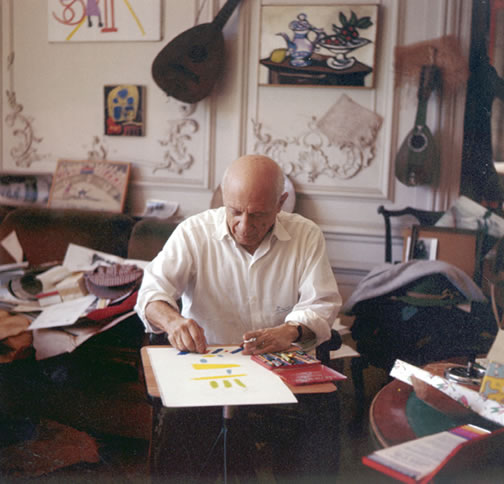
Picasso was the first rock-star artist, whose wild visions gripped the public imagination and changed 20th-century art for ever. But his flamboyant personality divided opinion. Was he a playful genius, as some suggest, or a capricious and cruel misanthrope who left battered lives in his wake? On the eve of a new show in London, we speak to his closest friends and family in a bid to unravel the enigma. “Picasso,” the surrealist poet Paul Eluard said, “paints like God or the devil.” Picasso favoured the first option. “I am God,” he was once heard telling himself. He muttered the mantra three times, boasting of his power to animate and enliven the visible world. Any line drawn by his hand…
Read More