On 27 Jan, 2011 With
Classical painting techniques – Sfumato Sfumato is one of the four canonical painting modes of the Renaissance (the other three being Cangiante, Chiaroscuro, and Unione). It corresponds to the concept of ‘low-contrast’ in photography. The Italian word sfumato (pp. of sfumare, ‘to vanish’ or ‘to shade’) captures the idea precisely. The finished product appears as though a veil of smoke had drifted between the subject of the painting and the viewer, adding some brightness to the pure darks and blocking some of the pure brights of the subject. It is not a difficult technique in practice. It requires competence in brushwork and judgement of value (brightness) but does not necessarily require a high degree of skill. It consists in painting…
Read More
On 25 Jan, 2011 With
Painting techniques – Cangiante Cangiante is one of the four canonical painting modes of the Renaissance (the other three being Unione, Chiaroscuro, and Sfumato). The word itself derives from the Italian cangiare (“to change”). Cangiante is characterized by the painter’s changing to a different, lighter, hue when the original hue cannot be made light enough or, on the converse, changing to a darker hue when the original hue cannot be made dark enough. The painter may change, for example, from the color yellow to the color red (regardless of the object’s actual color) when painting shadows on a yellow object simply because the yellow he has to work with cannot be made dark enough to render shadows on that object…
Read More
On 23 Jan, 2011 With
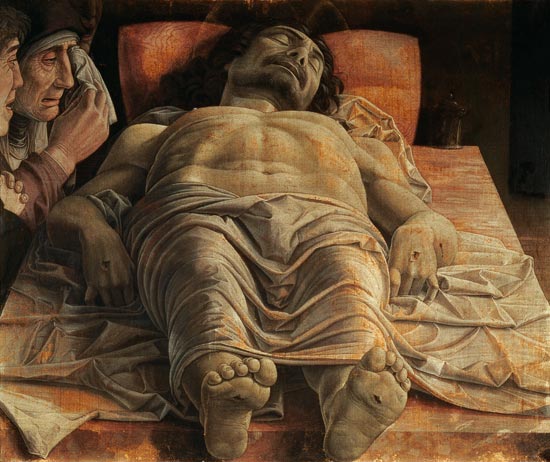
Classical painting techniques in Renaissance – Foreshortening Part 4 Foreshortening refers to the visual effect or optical illusion that an object or distance appears shorter than it actually is because it is angled toward the viewer. Although foreshortening is an important element in art where visual perspective is being depicted, foreshortening occurs in other types of two-dimensional representations of three-dimensional scenes. Some other types where foreshortening can occur include oblique parallel projection drawings. Figure F1 shows two different projections of a stack of two cubes, illustrating oblique parallel projection foreshortening (“A”) and perspective foreshortening (“B”). This technique was often used in Renaissance painting.
Read More
On 21 Jan, 2011 With
Classical painting techniques: Perspective Part 3 The use of Perspective: The first major treatment of the painting as a window into space appeared in the work of Giotto di Bondone, at the beginning of the 14th century. True linear perspective was formalized later, by Filippo BrunelleschiLeon Battista Alberti. In addition to giving a more realistic presentation of art, it moved Renaissance painters into composing more paintings. Prior to the Renaissance, a clearly modern optical basis of perspective was given in 1021, when Alhazen (al-Hasan Ibn al-Haytham, d. ca. 1041 CE), an Iraqi physicist and mathematician, in his Book of Optics (Kitab al-manazir; known in Latin as De aspectibus or Perspectiva), explained that light projects conically into the eye. Alhazen’s geometrical,…
Read More
On 20 Jan, 2011 With
Classical painting techniques – Renaissance art Part 2 Influences: The influences upon the development of Renaissance art in the early 15th century are those that also affected Philosophy, Literature, Architecture, Theology, Science, Government and other aspects of society. The following list presents a summary, dealt with more fully in the main articles that are cited above. 1. Classical texts, lost to European scholars for centuries, became available. These included Philosophy, Poetry, Drama, Science, a thesis on the Arts and Early Christian Theology. 2. Simultaneously, Europe gained access to advanced mathematics which had its provenance in the works of Islamic scholars. 3. The advent of movable type printing in the 15th century meant that ideas could be disseminated easily, and an…
Read More
On 19 Jan, 2011 With
Classical painting techniques. Part 1 Renaissance art is the painting, sculpture and decorative arts of that period of European history known as the Renaissance, emerging as a distinct style in Italy in about 1400, in parallel with developments which occurred in philosophy, literature, music and science. Renaissance art, perceived as a “rebirth” of ancient traditions, took as its foundation the art of Classical antiquity, but transformed that tradition by the absorption of recent developments in the art of Northern Europe and by application of contemporary scientific knowledge. Renaissance art, with Renaissance Humanist philosophy, spread throughout Europe, affecting both artists and their patrons with the development of new techniques and new artistic sensibilities. Renaissance art marks the transition of Europe from…
Read More
On 18 Jan, 2011 With
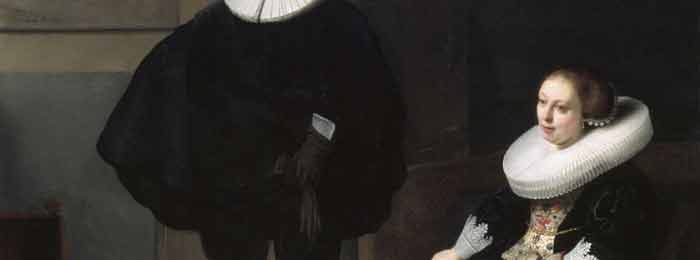
The biggest art theft in American history occurred at the Isabella Stewart Gardner Museum in Boston on March 18, 1990. The stolen paintings, including the one that hung in this frame, Rembrandt’s “Lady and Gentleman in Black,” remain unrecovered. It was the art heist of the century, and 20 years on, Boston billboards are being used to jog the public’s memory, reportsTom Moroney ART LOVERS who didn’t catch Rembrandt’s The Storm on the Sea of Galilee at the Isabella Stewart Gardner Museum before 1990 can now see it on electronic billboards outside Boston – courtesy of the FBI. Twenty years ago, on March 18th, the Dutch master’s only seascape, along with a dozen other artworks, disappeared from the museum. Two billboards…
Read More
On 17 Jan, 2011 With
Robert Dale Williams interviewed by Signy Norendal For the Norwegian magazine Aktuell Kitsch, September 5, 2007 When, why and how did you start painting? My ambitions were centered on illustration when I was younger. I always loved to tell stories with my drawings. My favorites were the very romantic or morally driven stories – the more sentimental the better. I once illustrated The Phantom of the Opera because I loved the dark romantic element to the story. My adaptation was never published on a large scale – I just loved illustrating the stories so much that I did it without thought of financial gain. Although I’d never say I completely “mastered” illustration, I wanted a greater challenge when I began…
Read More
On 12 Jan, 2011 With
Art Terms: Grisaille Grisaille is a term for painting executed entirely in monochrome or near-monochrome, usually in shades of grey. It is particularly used in large decorative schemes in imitation of sculpture. Many grisailles in fact include a slightly wider colour range, like the Andrea del Sarto fresco illustrated. Paintings executed in brown are sometimes referred to by the more specific term brunaille, and paintings executed in green are sometimes called verdaille. A grisaille may be executed for its own sake, as underpainting for an oil painting (in preparation for glazing layers of colour over it), or as a model for an engraver to work from. “Rubens and his school sometimes use monochrome techniques in sketching compositions for engravers.” Full…
Read More
On 11 Jan, 2011 With
In 1943 Picasso (age 62) then kept company with young art student Françoise Gilot (born in 1921). Their two children were Claude (1947) and Paloma (1949) who was named for the dove of peace that Picasso painted in support of the peace movement post World War II. Gilot, frustrated with Picasso’s relationships with other woman and his abusive nature left him in 1953. Gilot’s book “Life with Picasso” was published 11 years after their separation. In 1970 she married American physician-researcher Jonas Salk (who later died in 1995).
Read More