On 21 Oct, 2010 With
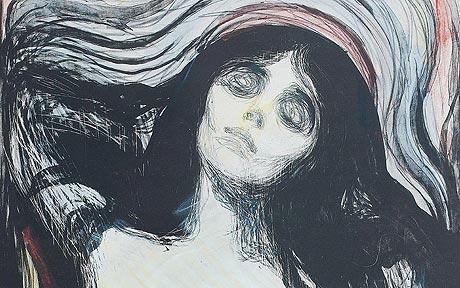
Edvard Munch’s Madonna sold for £1.25 million A hand-coloured image of Edvard Munch’s Madonna sold for £1.25 million today – doubling its estimate and making it the most expensive print ever to be sold in the UK. The controversial artwork, in Munch’s famous swirling style, had been estimated to fetch £500,000 to £700,000 at Bonhams Prints sale in London. Bonhams said that as well as setting a UK record, the image was also the second most expensive print to be sold in the world. Another Munch work, Vampire II, sold in Oslo in 2007 for around £1,256,000. The Madonna artwork was snapped up at Bonhams by a private buyer from the United States, for £1,252,000 including buyer’s premium. The work,…
Read More
On 20 Oct, 2010 With
New media art New media art is a genre that encompasses artworks created with new media technologies, including digital art, computer graphics, computer animation, virtual art, Internet art, interactive art technologies, computer robotics, and art as biotechnology. The term differentiates itself by its resulting cultural objects and social events, which can be seen in opposition to those deriving from old visual arts (i.e. traditional painting, sculpture, etc.) This concern with medium is a key feature of much contemporary art and indeed many art schools and major Universities now offer majors in “New Genres” or “New Media”. New Media Art often involves interaction between artist and observer. New Media concerns are often derived from the telecommunications, mass media and digital modes of delivery the artworks involve, with practices ranging from conceptual to virtual art, performance to installation.
Read More
On 19 Oct, 2010 With
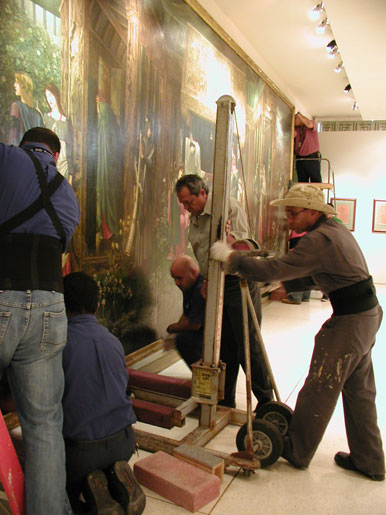
Edward Burne-Jones Tate puts costly error on display By Nigel Reynolds, Arts Correspondent Four decades ago, the Tate Gallery could have bought Edward Burne-Jones’s huge final painting, The Sleep of Arthur in Avalon, for £1,000. But the Victorian Pre-Raphaelites were despised and the gallery spurned the chance. Now, the 21ft by 10ft painting is worth millions and on Tuesday Tate Britain welcomed it back – but only on loan. Stephen Deuchar, the director of Tate Britain, admitted that his predecessors made a serious error of judgment. He said: “There is not a shadow of a doubt that this is Burne-Jones’s late great masterpiece. These days it would be fought over.” Burne-Jones spent 17 years on the canvas and he was…
Read More
On 18 Oct, 2010 With
Sir George Sitwell (father of the famous writer Dame Edith Sitwell) was a very bizarre man in many ways. He was a keen gardener (he actually studied garden design) and, annoyed by the wasps in his garden, he invented a pistol for shooting them. After he moved to Italy to avoid taxes in Britain, he refused to pay his new wife’s debts which resulted in her spending three months in prison. He was such an avid reader and collector of books that he had seven libraries in his home. Other eccentricities included paying his son an allowance based on the amount paid by one of his forebears to his son during the Black Death, and trying to pay his son’s Eton school…
Read More
On 17 Oct, 2010 With
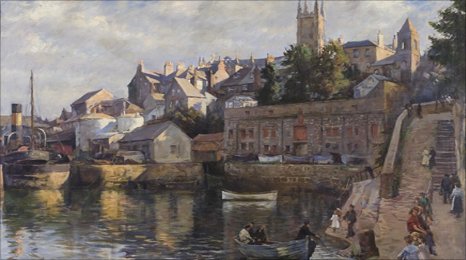
A three month public campaign has seen the painting ‘Inner Harbour – Abbey Slip’ by Stanhope Forbes saved. Grants of £130,000 together with generous donations from many private individuals has meant the iconic view of Penzance is secure. Painted in 1921 the painting is loved throughout the country through its use on greetings cards and prints. It will now continue to be displayed less than half a mile from where it was painted. The success of the fundraising campaign means this important part of Cornish heritage is available for everyone to enjoy at Penlee House Gallery & Museum. For thirty years the National Heritage Memorial Fund has been saving the nation’s most important treasures and now this piece of quintessentially…
Read More
On 16 Oct, 2010 With
Software art Software art refers to works of art where the creation of software, or concepts from software, play an important role; for example software applications which were created by artists and which were intended as artworks. As an artistic discipline software art has attained growing attention since the late 1990s. It is closely related to Internet art since it often relies on the Internet, most notably the World Wide Web, for dissemination and critical discussion of the works. Art festivals such as FILE Electronic Language International Festival (São Paulo),Transmediale (Berlin), Prix Ars Electronica (Linz) and readme (Moskow, Helsinki, Aarhus, Dortmund) have devoted considerable attention to the medium and through this have helped to bring software art to a wider audience of theorists and academics.
Read More
On 15 Oct, 2010 With
A 75-year-old Surrey woman cleared out her attic and found two paintings that could fetch up to £30,000 at auction. The woman decided she wanted to throw the oil paintings away, but first went to her neighbour Spencer Wright to ask how to dispose of them. Mr Wright said he realised they should not be consigned to the bin, and used an iPhone app to contact Christie’s. He said a specialist immediately knew the value of the paintings, by Australian artist William Blamire Young. The paintings – Light Horse and Artillery – had been bought by the woman’s father 60 years ago, but were kept in the attic because her mother did not like them. ‘Headed for dump’ Mr Wright…
Read More
On 14 Oct, 2010 With
Portrait of a Woman, attributed to Goya(1746-1828). X-ray images taken of this painting in 1954, revealed a portrait of another woman, circa 1790, beneath the surface. X-ray diffraction analysis revealed the presence ofzinc white paint, invented after Goya’s death. Further analysis revealed that the surface paint was modern and had been applied so as not to obscure the craquelure of the original. After analysis, the conservators left the work as you see it above, with portions of old and new visible, to illustrate the intricacies of art forgery, and the inherent difficulty of detecting it. Art forgery refers to creating and, in particular, selling works of art that are falsely attributed to be work of another, usually more famous, artist. Art forgery is extremely…
Read More
On 13 Oct, 2010 With
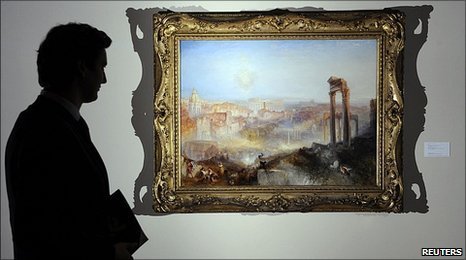
An 1839 Turner masterpiece of a view of Rome has sold for £29.7m in London, breaking the artist’s auction record. Modern Rome – Campo Vaccino sold in five minutes with six bidders battling for the work which has only come up for sale once before, Sotheby’s said. The previous record was the £20.5m paid in 2006 for Venice painting Giudecca, La Donna della Salute and San Giorgio. Modern Rome, which had an estimate of £12m-£18m, was the top seller at the Old Master and British Paintings sale. Other highlights included Dutch artist Jan Lievens’ study of the head and shoulders of an old bearded man wearing a cap (circa 1629), which brought £2.5m against an estimate of £2-3m. TURNER AUCTIONS:…
Read More
On 12 Oct, 2010 With
Sitwell, Dame Edith Edith Sitwell Dame Edith Louisa Sitwell DBE (7 September 1887 – 9 December 1964) was a British poet and critic. Background Edith Sitwell was born in Scarborough, Yorkshire, the only daughter of the eccentric Sir George Sitwell, 4th Baronet, of Renishaw Hall; he was an expert on genealogy and landscaping. Her mother was the former Lady Ida Emily Augusta Denison, a daughter of the Earl of Londesborough and a granddaughter of Henry Somerset, 7th Duke of Beaufort. She claimed a descent through female lines from thePlantagenets. Sitwell had two younger brothers, Osbert (1892-1969) and Sacheverell Sitwell (1897-1988) both distinguished authors, well-known literary figures in their own right, and long-term collaborators. Sacheverell married a Canadian woman, Georgia Doble, in 1925 and moved to Weston Hall in Northamptonshire….
Read More