On 2 Oct, 2010 With
Peredvizhniki (Russian pronounced as Pear-rad-veezh-niki, often calledThe Wanderers or The Itinerants in English, were a group of Russian realist artists who in protest at academic restrictions formed an artists’ cooperative which evolved into the Society for Traveling Art Exhibitionsin 1870. History The society formed in 1870 in St. Petersburg under Ivan Kramskoi, Grigoriy Myasoyedov, Nikolai Ge and Vasily Perov’s initiative during a struggle of the avant-garde art forces of the country for democratic ideals, and in a counterbalance to the official center of art—the St.Petersburg Academy of Arts. The society developed the best traditions of the Artel of Artists headed by Kramskoi, who became the leader of the new association. Peredvizhniki were influenced by the public and aesthetic views of Vissarion Belinsky and Nikolai Chernyshevsky. Like most Slavophiles, Chernyshevsky was a liberal and ardently supported…
Read More
On 1 Oct, 2010 With
Concerning his picture of Theodore and Honorio, Fuseli used to say, “Look at it—it is connected with the first patron I ever had.” He then proceeded to relate how Cipriani had undertaken to paint for Horace Walpole a scene from Boccaccio’s Theodore and Honorio, familiar to all in the splendid translation of Dryden, and, after several attempts, finding the subject too heavy for his handling, he said to Walpole, “I cannot please myself with a sketch from this most imaginative of Gothic fictions; but I know one who can do the story justice—a man of great powers, of the name of Fuseli.” “Let me see this painter of yours,” said the other. Fuseli was sent for, and soon satisfied Walpole…
Read More
On 30 Sep, 2010 With
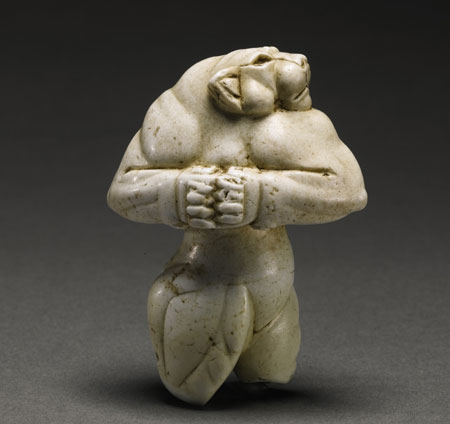
The highest auction price ever achieved by a sculpture 2007: The highest auction price ever achieved by a sculpture: the 5,000-year old Guennol Lioness, a 3 1/4-inch limestone lion from ancient Mesopotamia. Sold for $57 million. Source: visual-arts-cork.com
Read More
On 29 Sep, 2010 With
His rising fame, his poetic feeling, his great knowledge, and his greater confidence, now induced Fuseli to commence an undertaking worthy of the highest genius—the Shakspeare Gallery. An accidental conversation at the table of the nephew of Alderman Boydell, started, as it is said, the idea; and West, Romney, and Hayley shared with Fuseli in the honor. But to the mind of the latter, such a scheme had been long present; it dawned on his fancy in Rome, even as he lay on his back marveling in the Sistine, and he saw in imagination a long and shadowy succession of pictures. He figured to himself a magnificent temple, and filled it, as the illustrious artists of Italy did the Sistine,…
Read More
On 28 Sep, 2010 With
The Macchiaioli were a group of Italian painters from Tuscany, active in the second half of the nineteenth century, who, breaking with the antiquated conventions taught by the Italian academies of art, painted outdoors in order to capture natural light, shade, and colour. The Macchiaioli were forerunners of the Impressionists who, beginning in the 1860s, would pursue similar aims in France. The most notable artists of this movement were Giovanni Fattori, Silvestro Lega and Telemaco Signorini. The movement The movement grew from a small group of artists, many of whom had been revolutionaries in the uprisings of 1848. The artists met at the Caffè Michelangiolo in Florence throughout the 1850s to discuss art and politics. These idealistic young men, dissatisfied with the art of the academies, shared a wish…
Read More
On 27 Sep, 2010 With
Genuine fakes by Ben East Fakes and forgeries were once the embarrassment of the art world. No august gallery, no famous auction house is entirely free from the stain of a costly error of provenance. It was ever thus: one of the first acquisitions by the National Gallery in London was proudly unveiled in 1847 as a major painting by the 16th-century artist Hans Holbein. It was, they said, a purchase of “national significance”. But within weeks, doubt was cast on its authenticity, the attribution to Holbein was scrubbed and the gallery’s first director, Sir Charles Lock, resigned. Two centuries on, you’d forgive Lock a wry smile. Duped galleries and experts can now feel reassured that even if they do…
Read More
On 26 Sep, 2010 With
This picture was a work of far higher order than his “Nightmare,” although the latter caught the[Pg 67] public fancy most. It is distinguished by singular power, full of feeling and terror. The desolate old man is seated on the ground, and his whole frame seems inspired with a presentiment of the coming vengeance of heaven. His daughters are clasping him wildly, and the sky seems mustering the thunder and fire in which the tragic bard has made him disappear. “Pray, sir, what is that old man afraid of?” said some one to Fuseli, when the picture was exhibited. “Afraid, sir,” exclaimed the painter, “why, afraid of going to hell!”
Read More
On 25 Sep, 2010 With
The Vienna School of Fantastic Realism is a group of artists founded in Vienna in 1946. It includes Ernst Fuchs, Arik Brauer, Rudolf Hausner, Wolfgang Hutter, Anton Lehmden andFritz Janschka, all students of Professor Albert Paris Gütersloh at the Vienna Academy of Fine Arts. It was Gütersloh’s emphasis on the techniques of the Old Masters that gave the fantastic realist painters a grounding in realism (expressed with a clarity and detail some have compared to early Flemish painting) combined with religious and esoteric symbolism. Books 1974 – Die Wiener Schule des Phantastischen Realisumus (C. Bertelsmann) (Johann Muschik) (German language) 2005 – Fantastic Art (Taschen)(Schurian, Prof. Dr. Walter) (English edition) 2003 – Die Phantasten – Die Wiener Schule des Phantastischen Realisums (Stdtgemeinde Tulln) (German Language) 2007 – Metamorphosis (beinArt) 2008 – Phantastischer Realismus (Belvedere, Wien)…
Read More
On 24 Sep, 2010 With
Anti-art is a loosely-used term applied to an array of concepts and attitudes that reject prior definitions of art and question art in general. Anti-art tends to conduct this questioning and rejection from the vantage point of art. The term is associated with the Dada movement and is generally accepted as attributable to Marcel Duchamp pre-World War I, when he began to use found objects as art. An expression of anti-art can take the form of art or not. In general, anti-art rejects only some aspects of art. Depending on the case, “anti-artworks” may reject conventional artistic standards. Anti-artworks may also reject the art market, and high art. Anti-artworks may reject individualism in art. Anti-art may reject “universality” as an accepted factor in art,…
Read More
On 23 Sep, 2010 With
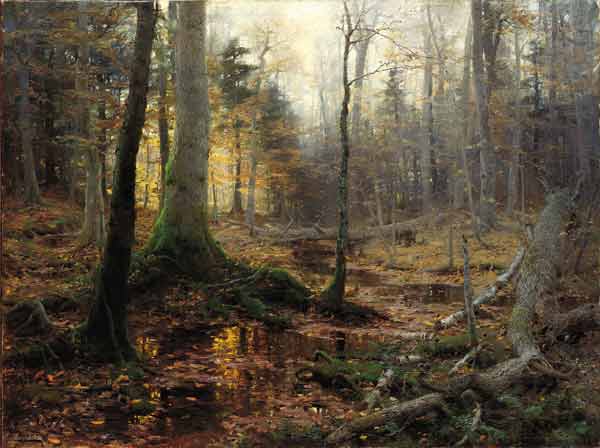
Naturalism Naturalism in art refers to the depiction of realistic objects in a natural setting. The Realism movement of the 19th century advocated naturalism in reaction to the stylized and idealized depictions of subjects in Romanticism, but many painters have adopted a similar approach over the centuries. One example of Naturalism is the artwork of American artist William Bliss Baker, whose landscape paintings are considered some of the best examples of the naturalist movement. Another example is the French Albert Charpin, from the Barbizon School,with his paintings of sheep in their natural settings. An important part of the naturalist movement was its Darwinian perspective of life and its view of the futility of man up against the forces of nature. Naturalism began in the…
Read More