On 11 Oct, 2010 With
White Center (Yellow, Pink and Lavender on Rose) by Mark Rothko • 2007: The second most expensive contemporary (ie. post-war) painting ever sold at auction: White Center (Yellow, Pink and Lavender on Rose) by Mark Rothko. Sold for $72.8 million.
Read More
On 10 Oct, 2010 With
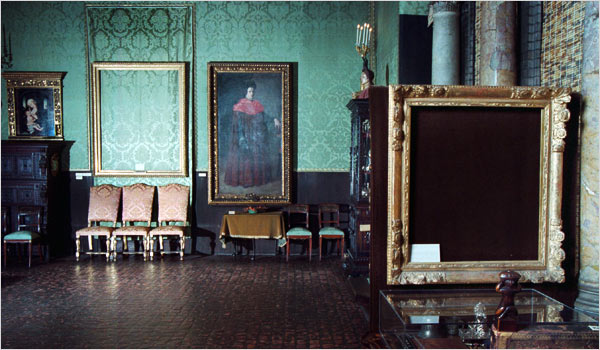
Boston art theft remains biggest unsolved mystery By John Wilson Vermeer’s The Concert is estimated to be worth around £200m The Gardner robbery remains the largest single property theft of all time As crime scenes go, it has got to be one of the most beautiful. The Dutch Room of the Isabella Stewart Gardner Museum in Boston is lined with green silk wallpaper, from terracotta cobbled floor to oak timbered ceiling. On one wall hangs a Van Dyck, on another a Rubens but these artworks are not the first things one notices in the first floor gallery. It is the empty frames that stop you in your tracks. One, an ornate gilded rectangle framing nothing but green wallpaper, once held…
Read More
On 8 Oct, 2010 With
Relational Art Relational Art or “Relational Aesthetics” is a mode or tendency in fine art practice originally observed and highlighted by French art critic Nicolas Bourriaud. Bourriaud defined the approach simply as, “a set of artistic practices which take as their theoretical and practical point of departure the whole of human relations and their social context, rather than an independent and private space.” Origin of the term One of the first attempts to analyze and categorize art from the 1990s, the idea of Relational Art was developed by Nicolas Bourriaud in 1998 in his book Esthétique relationnelle(Relational Aesthetics). The term was first used in 1996, in the catalogue for the exhibition Traffic curated by Bourriaud at CAPC musée d’Art contemporain de Bordeaux. Trafficincluded…
Read More
On 7 Oct, 2010 With
Visionary art is art that purports to transcend the physical world and portray a wider vision of awareness including spiritual or mysticalthemes, or is based in such experiences. Definition The American Visionary Art Museum defines Visionary art as “….art produced by self-taught individuals, usually without formal training, whose works arise from an innate personal vision that revels foremost in the creative act itself.” It goes on to say that visionary art is a product of an inner process, and may not even be thought of as art by its creator; it also differentiates Visionary art from Folk art. Alexander Beiner, host of Visionary Artists Podcast, has proposed an alternative definition, suggesting that “Visionary Art is any art that seeks to represent or explore mystical experience. As…
Read More
On 6 Oct, 2010 With
Jean-Léon Gérôme (May 11, 1824 – January 10, 1904) was a French painter and sculptor in the style now known as Academicism. The range of his oeuvre included historical painting, Greek mythology, Orientalism, portraits and other subjects, bringing the Academic painting tradition to an artistic climax. Life Jean-Léon Gérôme was born at Vesoul (Haute-Saône). He went to Paris in 1840 where he studied under Paul Delaroche, whom he accompanied to Italy (1843–1844). He visited Florence, Rome, the Vatican and Pompeii, but he was more attracted to the world of nature. Taken by a fever, he was forced to return to Paris in 1844. On his return he followed, like many other students of Delaroche, into the atelier ofCharles Gleyre and studied there for a brief…
Read More
On 5 Oct, 2010 With
Dante Gabriel Rossetti. The Pre-Raphaelite Brotherhood (also known as the Pre-Raphaelites) was a group of English painters, poets, and critics, founded in 1848 by William Holman Hunt, John Everett Millais and Dante Gabriel Rossetti. The three founders were soon joined by William Michael Rossetti,James Collinson, Frederic George Stephens and Thomas Woolner to form a seven-member “brotherhood”. The group’s intention was to reform art by rejecting what they considered to be the mechanistic approach first adopted by the Mannerist artists who succeeded Raphael and Michelangelo. They believed that the Classical poses and elegant compositions of Raphael in particular had been a corrupting influence on the academic teaching of art. Hence the name “Pre-Raphaelite”. In particular, they objected to the influence of Sir Joshua Reynolds, the founder of the English Royal Academy of Arts. They called him “Sir Sloshua”,…
Read More
On 4 Oct, 2010 With
Visual Arts Salaries With the world wide crisis we are all experiencing, finding a stable job is a little bit difficult. With many competitors around, you must really have the right skills and knowledge to be on the edge against others. With technology leading the way, there is a very large demand for visual artists in different sub fields and positions. Visual arts mainly focus on everything visual like drawing, painting, and photography. If you have the passion for the visual arts, then by now you should enroll yourself to an art school and get a degree in any field of visual arts which you think suits you well. There are many good schools available that specialize in arts; you just…
Read More
On 4 Oct, 2010 With
Average weekly income for a visual artist: £521 (average figure based on highest and lowest earnings. Source: ONS). Amount paid for works sold at the annual Affordable Art Fair in London: £50–£3,000 (of which a percentage may go to an artist’s gallery). How does the average artist make a living? If you’re Damien Hirst, of course, you need only flog a couple of sharks in formaldehyde; if you’re Tracey Emin, an unmade bed will do. If you’re an actor, a well-publicised turn as Hamlet and near-omnipresence in the Christmas TV schedules, a la David Tennant, would keep the accountant happy. But none of these scenarios will ring true for the average artist – who is more likely to be stacking supermarket shelves,…
Read More
On 4 Oct, 2010 With
Young British Artists Young British Artists or YBAs (also referred to as Brit artists and Britart) is the name given to a group of conceptual artists, painters, sculptors and installation artists based in the United Kingdom, most (though not all) of whom attended Goldsmiths College in London. The term Young British Artists is derived from shows of that name staged at the Saatchi Gallery from 1992 onwards, which brought the artists to fame. It has become a historic term, as most of the YBAs are now in their forties. They are noted for “shock tactics”, use of throwaway materials and wild-living, and are (or were) associated with the Hoxton area of East London. They achieved considerable media coverage and dominated British art during the 1990s. Leading artists of the group…
Read More
On 3 Oct, 2010 With
Street art is any art developed in public spaces — that is, “in the streets” — though the term usually refers to unsanctioned art, as opposed to government sponsored initiatives. The term can include traditional graffiti artwork, stencil graffiti, sticker art, wheatpasting and street poster art, video projection, art intervention, guerrilla art, flash mobbing and street installations. Typically, the term street art or the more specificpost-graffiti is used to distinguish contemporary public-space artwork from territorial graffiti, vandalism, and corporate art. Artists have challenged art by situating it in non-art contexts. ‘Street’ artists do not aspire to change the definition of an artwork, but rather to question the existing environment with its own language. They attempt to have their work communicate with everyday people about socially relevant themes in ways that are informed by…
Read More