On 7 Aug, 2012 With
Oil painting materials: CANVASES and STRETCHERS Grain.—The question of grain is not easy to speak about without the canvas, yet it is often a matter of importance. There are many kinds of surface, from the most smooth to the most rugged. Some grain it is well the canvas should have; too great smoothness will tend to make the painting “slick,” which is not a pleasant quality. A grain gives the canvas a “tooth,” and takes the paint better. Just what grain is best depends on the work. If you are going to have very fine detail in the picture use a smoothish canvas; but whenever you are going to paint heavily, roughly, or loosely, the rough canvas takes the paint…
Read More
On 5 Aug, 2012 With
Oil painting materials: CANVASES, STRETCHERS AND PANELS You should have plenty of canvas on hand, and it would be well if you had it all stretched ready for use. Many a good day’s work is lost because of the time wasted in getting a canvas ready. It is not necessary to have many kinds or sizes. It is better in fact to settle on one kind of surface which suits you, and to have a few practical sizes of stretchers which will pack together well, and work always on these. You will find that by getting accustomed to these sizes you work more freely on them. You can pack them better, and you can frame them more conveniently, because one frame…
Read More
On 4 Aug, 2012 With
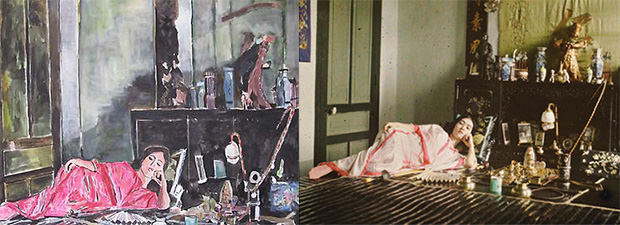
Singer Bob Dylan accused of plagiarizing photographs Singer Bob Dylan is being accused of plagiarism after several paintings in his recent art show were found to have “striking resemblances” to works by photographers such as Henri Cartier-Bresson, Dmitri Kessel and Léon Busy. An example is Dylan’s painting titled Opium(above left), which appears to be directly copied from Busy’s Vietnam (above right). Dylan had copied six photographs — one of which an artificial Photoshop edit — from his Flickr stream. In response, the gallery hosting the show changed the exhibition’s description from a “visual diary” of Dylan’s travels to a “visual reflection”. A spokesperson tells The Guardian: “While the composition of some of Bob Dylan’s paintings are based on a variety of sources, including archival, historic images,…
Read More
On 1 Aug, 2012 With
How to economize on Oil Painting Tools There is a false implication in the saying that “a poor workman blames his tools.” It is not true that a good workman can do good work with bad tools. On the contrary, the good workman sees to it that he has good tools, and makes it a part of his good workmanship that they are in good condition. In painting there is nothing that will cause you more trouble than bad materials. You can get along with few materials, but you cannot get along with bad ones. That is not the place to economize. To do good work is difficult at best. Economize where it will not be a hindrance to you. Your…
Read More
On 31 Jul, 2012 With
Acrylic painting techniques How to Make a Painting Look Old 1. Allow the painting to dry if just completed. Apply clear acrylic to the painting to act as a base for the crackle paint application that will give your painting some age. The clear acrylic should be applied evenly to the surface of the painting following the original brush strokes. Allow the clear acrylic to dry before moving forward. 2. Prepare the crackle paint by adding the colors to it that closely match the areas you are trying to age prematurely. Not using color will result in the crackle paint turning white. Use colors that match the painting so that when it dries, it will look as though the paint is aged. Use…
Read More
On 8 May, 2012 With
The two men pulled up in the driveway of the two-star country hotel, looking for all the world like travelling salesmen stopping off for a night’s rest between appointments. But the rectangular package on the back seat of their car contained something rather more valuable than catalogues or brochures. Only once they were in the privacy of a locked room, the curtains firmly closed, did private detectives Robbie Graham and Jack Doyle dare to unwrap the treasure they had just rescued from the criminal underworld. And then they just sat and stared at it in wonder, scarcely able to believe what they were seeing. On that October night in 2007, they took snapshots of themselves posing next to it, using…
Read More
On 1 May, 2012 With
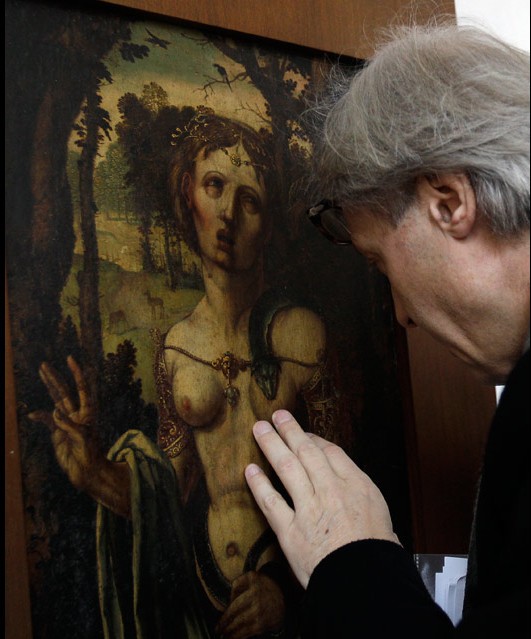
STOLEN ARTWORKS TO BE RETURNED The Carabinieri art squad recovered 16 paintings stolen over a period of decades in the house of a Roman designer. The designer has been charged with receiving stolen goods. His collection is enormous. Police found 180 paintings from a variety of periods reportedly purchased in markets and fairs over the past 30 years. Authorities were tipped off to the collection by a would-be buyer. Unlike the accused, this collector, who was hoping to buy a 15th c. painting of the Sienese school, checked with the Carabinieri art squad to ensure the piece was legitimately owned by the seller. The squad looked into the collection and found one piece listed in their stolen art database: Suicide…
Read More
On 21 Apr, 2012 With
The controversial Restoration of Holbein’s “Ambassadors” The Early Music pioneer (Sir) John Eliot Gardiner recently left the Daily Telegraph’s music critic, Ivan Hewett, reeling with incredulity by saying that he had not seen himself as a crusading musicological force but simply as a jobbing musician who recognised that “other views are valid, as long as they’re convincing in performance”. For Hewett, Gardiner had long epitomised the radical movement to “scrape the varnish” off music by playing on obsolete period instruments and eschewing later styles and types of musical understanding in attempt to produce historically authentic performances. For over half a century after the Second World War picture restorers at the National Gallery, London, sought to recover the historically authentic appearances of paintings by first removing…
Read More
On 19 Apr, 2012 With
The Controversial Restoration of Michelangelo’s Sistine Chapel Ceiling No single proof of a restoration-induced injury to a work of art could be clearer than the photograph shown here (Fig. 1) of a section of Michelangelo’s Sistine Chapel ceiling frescoes. It was taken after the last restoration and shows in its centre section a repair made in 1566 by the painter Domenico Carnevale when a section of Michelangelo’s fresco fell away during settlement of the building (see Fig. 2 diagram). Carnevale had re-plastered the loss and, while the plaster surface was still wet, faithfully painted it to match Michelangelo’s (then) surrounding colours and tones. The repair was a good one and for centuries it remained almost invisible (see Figs….
Read More
On 2 Feb, 2012 With
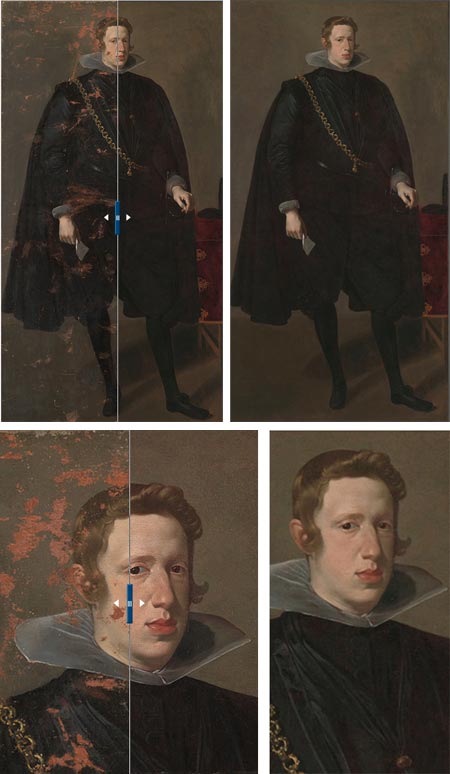
The Restoration of a Velázquez In 1973, for reasons still not clear to me, the Metropolitan Museum of Art in New York undertook a sweeping reassessment of many of its holdings, resulting in the downgrading of 300 old master paintings from attribution to the master to attribution to “workshop of”, “circle of” or “follower of”, removing them from the canon of those masters’ works and significantly depleting the value of the museum’s collection. Some of those pieces have been again reassessed, both in the light of continued scholarship and as the result of subsequent cleanings and restorations. Last year the Met cleaned and restored Velázquez’s Portrait of a Man, and in the process restored it to it’s original attribution — originating…
Read More