On 11 Aug, 2011 With
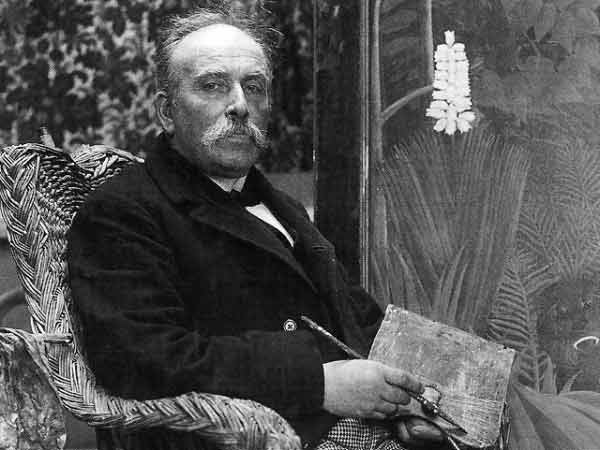
A French Naive or Primitive painter. Henri Rousseau was also known as Le Douanier (the customs officer), a humorous description of his occupation as a tax collector. Ridiculed during his life, he came to be recognized as a self-taught genius whose works are of high artistic quality. Henri Rousseau was born in Laval, France into the family of a tinsmith. He attended Laval High School as a day student and then as a boarder. He was mediocre in some subjects at the high school but won prizes for drawing and music. He worked for a lawyer and studied law, but “attempted a small perjury and sought refuge in the army,” serving for four years, starting in 1863. With his father’s death, Rousseau moved to Paris in…
Read More
On 10 Aug, 2011 With
An English Classical Realist painter and sculptor. Frederic Leighton, 1st Baron Leighton, an English Classical Realist painter and sculptor. His works depicted historical, biblical and classical subject matter. The Classical Realist movement is currently sustained through art schools based on the Atelier Method. These ateliers are founded with the goal of revitalizing art education by reintroducing rigorous training in traditional drawing and painting techniques, employing teaching methodologies that were used in the Ecole des Beaux-Arts. These schools pass on a method of instruction which melds formal academic art training with the influence of the French Impressionists. Under the atelier model, art students study in the studio of an established master to learn how to draw and paint with realistic accuracy and an emphasis on rendering form convincingly. The foundation of these programs rests on an intensive study of the human figure, renderings of plaster casts of classical sculpture, and the…
Read More
On 6 Aug, 2011 With
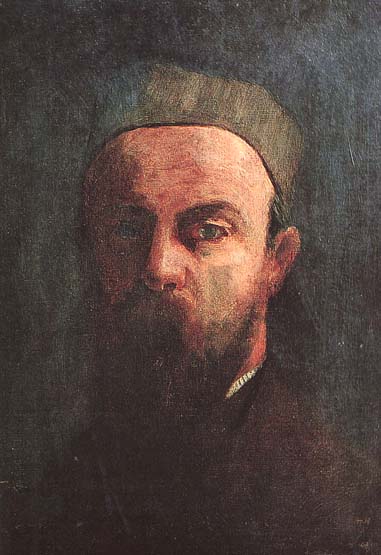
A French symbolist painter, printmaker, draughtsman and pastellist. Odilon Redon was born in Bordeaux, Aquitaine, to a prosperous family. He started drawing as a child, and at the age of ten he was awarded a drawing prize at school. Aged fifteen, he began the formal study of drawing, but on the insistence of his father he changed to architecture. His failure to pass the entrance exams at Paris’ École des Beaux-Arts ended any plans for a career as an architect, although he briefly studied painting there under Jean-Léon Gérôme in 1864. (His younger brother Gaston Redon would become a noted architect.) Back home in his native Bordeaux, he took up sculpture, and Rodolphe Bresdin instructed him in etching and lithography….
Read More
On 5 Aug, 2011 With
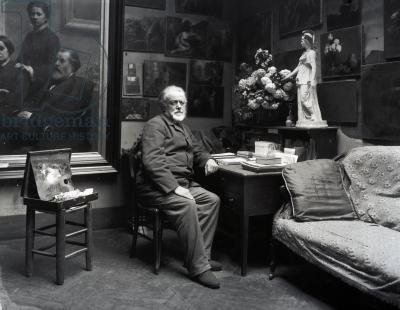
Henri Fantin-Latour (14 January 1836 – 25 August 1904) was a French painter and lithographer best known for his flower paintings and group portraits of Parisian artists and writers. As a youth, he received drawing lessons from his father, who was an artist. In 1850 he entered the Ecole de Dessin, where he studied with Lecoq de Boisbaudran. After studying at the École des Beaux-Arts in Paris from 1854, he devoted much time to copying the works of the old masters in the Louvre. Although he befriended several of the young artists who would later be associated with Impressionism, including Whistler and Manet, Fantin’s own work remained conservative and classical in style. Whistler brought attention to Fantin in England, where his still-lifes sold so well that they were “practically unknown in France during his lifetime”. In addition to his realistic paintings, Fantin-Latour created imaginative lithographs inspired by…
Read More
On 4 Aug, 2011 With
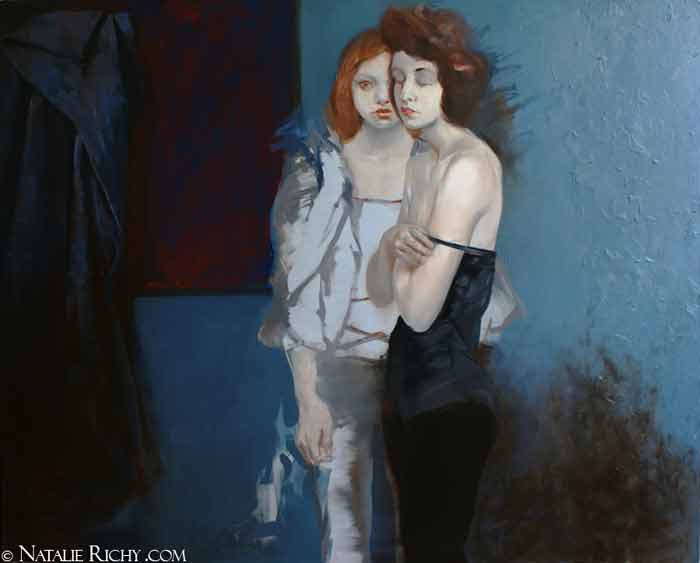
This Video shows the creation of the figurative painting. The canvas is toned with a thin layer of oil imprimatura, and the two figure drawing is done in sanguine. The oil painting approach is one of simplification of form and colour. In contrast to the clarity with which Natalie describes faces, details of the dress and drapery are done in loose brushstrokes and are stylised impressionistically. The composition of the painting is located in fictive surroundings. The elegant blue colours in the painting suggest nostalgia, which ads imaginative and aesthetic significance. Natalie brought to this figurative picture a modern sensibility, impressionistic effects and painterly fluency.
Read More
On 3 Aug, 2011 With
The Video Lesson “How to Paint a Portrait in Oil” demonstrates the oil painting technique in the style of an 18th century Paris salon, explained in specific, sequential steps. From the positioning of the figure to the details of the background, this easy-to-follow process will give you the discipline and focus that the difficult art of portraiture demands. Oil painting is the process of painting with pigments that are bound with a medium of drying oil — especially in early modern Europe, linseed oil. Often an oil such as linseed was boiled with a resin such as pine resin or even frankincense; these were called ‘varnishes’ and were prized for their body and gloss. Other oils occasionally used include poppyseed oil, walnut oil, and safflower oil. These oils confer various…
Read More
On 2 Aug, 2011 With
This Video Lesson presents an example of making two drawings in which you will learn how to draw relying on unique lose strokes only. You will be able to create your drawings fast, freshly, impressive, emotionally fulfilled and reminding the etching effect. Such technique is great for both preparatory sketches and finished artworks. Video is based on two drawings made by Natalie Richy. No one really knows when art or drawing really began. Humans supposedly made sketches and painting in the early years. Cave Paintings are a good example. People have made rock and cavedrawings since prehistoric times. By the 12th-13th centuries AD, monks were preparing illuminated manuscripts on vellum or parchment in monasteries throughout Europe were using lead styli to draw lines for their writings…
Read More
On 29 Jul, 2011 With
Part 2 The beginning of this article The technique used is quite laborious, involving small circular or oval strokes with a sanguine pencil. If you have ever worked in lithography, you may notice that drawing with wax sanguine on the paper and using a lithography pencil on the lithography stone gives the same feeling of the surface. This is because the viscosity of pencils and the circular movements are similar, whether working in wax sanguine or doing lithography. The circular pencil movements are best suited for when the surface needs to be evenly filled in. The pressure of the sanguine pencil should be varied. The more gentle the pressure, the lighter the result. In the shadow places, more pressure should be applied. Layer…
Read More
On 28 Jul, 2011 With
Join the Club to view this Video Lesson » Part 1 This Video Lesson presents the drawing with sanguine. It demonstrates how to capture effects of light and shadow on a drawing of antique bas-relief sculpture. How to use sanguine and white chalk on toned paper. This exercise of sanguine drawingwill improve your drawing experience and skills of depicting 3-demensional objects on flat surface of toned paper. In this video we are going to make a study of a fragment of the Parthenon sculpture in sanguine technique. We begin with transferring the drawing outline and finish with the white chalk highlighting. For the Parthenon sculpture study we have chosen a good quality, unevenly tinted thick paper, which is very similar…
Read More
On 26 Jul, 2011 With
This Video Lesson presents an example of making two drawings in which you will learn how to draw relying on unique lose strokes only. You will be able to create your drawings fast, freshly, impressive, emotionally fulfilled and reminding the etching effect. Such technique is great for both preparatory sketches and finished artworks. Video is based on two drawings made by Natalie Richy. Here is another good example of portrait drawing where you can achieve great results with a minimalist approach. This drawing is done in the same style as the previous one. Graphite drawing techniques are virtually endless. Any way that you choose to apply graphite to a surface will produce some sort of interesting result. To begin with,…
Read More